Currency
 AED
AED
 AFN
AFN
 AMD
AMD
 ANG
ANG
 AUD
AUD
 AWG
AWG
 AZN
AZN
 BAM
BAM
 BBD
BBD
 BDT
BDT
 BIF
BIF
 BND
BND
 BOB
BOB
 BSD
BSD
 BWP
BWP
 BZD
BZD
 CAD
CAD
 CDF
CDF
 CHF
CHF
 CNY
CNY
 CRC
CRC
 CVE
CVE
 CZK
CZK
 DJF
DJF
 DKK
DKK
 DOP
DOP
 EGP
EGP
 ETB
ETB
 EUR
EUR
 FJD
FJD
 FKP
FKP
 GBP
GBP
 GMD
GMD
 GNF
GNF
 GTQ
GTQ
 GYD
GYD
 HKD
HKD
 HNL
HNL
 HUF
HUF
 IDR
IDR
 ILS
ILS
 ISK
ISK
 JMD
JMD
 JPY
JPY
 KES
KES
 KGS
KGS
 KHR
KHR
 KMF
KMF
 KYD
KYD
 KZT
KZT
 LAK
LAK
 LBP
LBP
 LKR
LKR
 MAD
MAD
 MDL
MDL
 MKD
MKD
 MMK
MMK
 MNT
MNT
 MOP
MOP
 MUR
MUR
 MVR
MVR
 MWK
MWK
 MYR
MYR
 NGN
NGN
 NIO
NIO
 NPR
NPR
 NZD
NZD
 PEN
PEN
 PGK
PGK
 PHP
PHP
 PKR
PKR
 PLN
PLN
 PYG
PYG
 QAR
QAR
 RON
RON
 RSD
RSD
 RWF
RWF
 SAR
SAR
 SBD
SBD
 SEK
SEK
 SGD
SGD
 SHP
SHP
 SLL
SLL
 STD
STD
 THB
THB
 TJS
TJS
 TOP
TOP
 TTD
TTD
 TWD
TWD
 TZS
TZS
 UAH
UAH
 UGX
UGX
 USD
USD
 UYU
UYU
 UZS
UZS
 VND
VND
 VUV
VUV
 WST
WST
 XAF
XAF
 XCD
XOF
XPF
XCD
XOF
XPF
 YER
YER

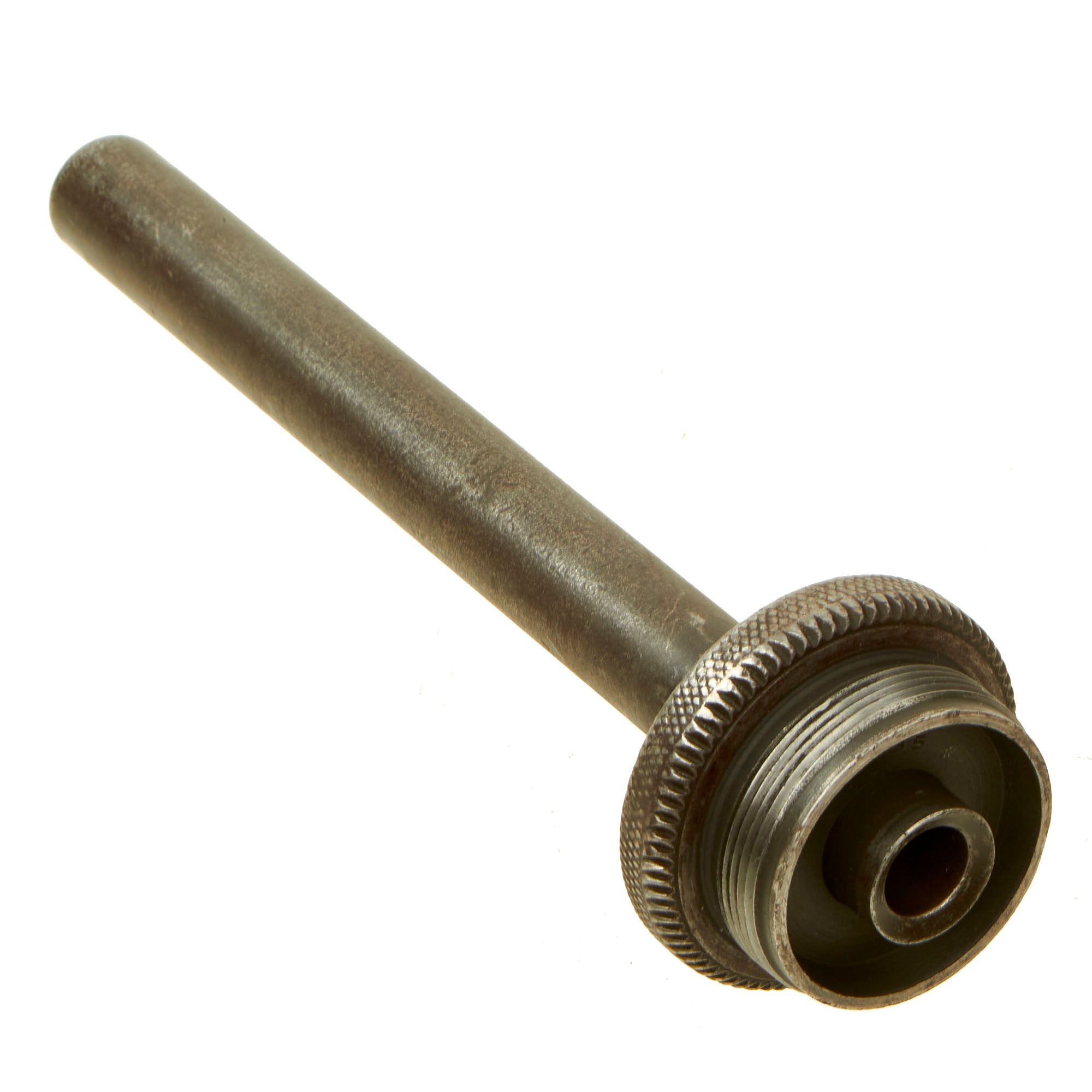


Description
xOriginal Item: Only One Available. This is a very nice WWII Type Barrel Assembly for the M3A1 .45cal Submachine gun, made during the 1950s by Ithaca Gun Company. It features the barrel itself and is pinned into the heavy muzzle nut, which is marked with stock number C5653435 on the inside, with ITG on the bottom for the maker Ithica.
It is in very good condition, still showing much of the original parkerized finish on the nut, while the barrel shows a bit more wear to the finish. The bore of the barrel is in very good condition, showing strong lands and grooves with a bright finish. There is just a bit of light wear from use. This would be perfect for a parts set that was imported without a barrel!
The M3 submachine gun, also known as Grease Gun, was developed as a cheaper war-time alternative to famous Thompson M1 and M1928 submachine guns. The basic requirements were set by US Ordnance Corps in February, 1941. George Hyde and Frederick Sampson, working together at Inland Division of general Motors Corp developed a prototype, which was designated the T20. The T-20 was a very simple weapon, made mostly from steel stampings. In November 1942 T20 was tested against several other prototypes, and was found superior to all other contestants. Late in 1942 the T20 was recommended for adoption, which followed in 1943. Combat use of a newly adopted M3 submachine gun showed some problematic points in design, most notably in the failing cocking mechanism. The problems were solved by elimination of this unit in 1944 when a further simplified weapon received the designation M3A1, and served with US Armed forces through the later part of WWII, Korean and Vietnam wars. M3A1 was issued to US tank crews all the way up until 1980s.
Its steel stamped construction made this the much less costly successor to the Thompson and Reising sub-machine guns of WWII. It has an interesting safety mechanism that when the bolt is back and the ejector port cover is closed, a tab on the cover holds the bolt in the rear position, even when the trigger is actuated. One must open the ejector port cover in order for the bolt to move forward and fire.
In the early 1950s, Ithaca Gun Company was at first contracted to manufacture bolts for the M3A1, and later, as the Korean conflict escalated, more were ordered. Ithaca was contracted through the Rochester, New York Ordnance District to fabricate 70,000 new M3A1 submachine guns to fill the need.
M3 submachine gun was a full-automatic blowback-operated firearm that fired from an open bolt. The receiver was made from steel stampings. M3 featured spring-loaded ejection port cover (which also acted as safety, locking the bolt when it is closed) and crank-type bolt retracting (cocking) handle at the right side of the receiver.
Characteristics include:
Caliber: .45ACP
Weight: 3.7 kg
Length (stock closed/open): 570 / 745 mm
Barrel length: 203 mm
Rate of fire: ca. 450 rounds per minute
Magazine capacity: 30 rounds
Effective range: 50 meters


- Choosing a selection results in a full page refresh.